Tuesday, 26 June 2018

Food Production Operations-Introduction

What is Cookery?

Cookery is an art and science of preparing food for consumption by using heat. Cookery is an age-old practice. A primitive human must have found a piece of meat or vegetable cooked in the bushfire by chance. He must have found it edible, chewable and easy to consume. Probably, he even must not have cooked deliberately until he knew how to create fire.
The simplest method of cooking was holding a piece of meat or vegetable in the fire directly, which is still in practice, with a little sophistication. From the age-old cooking practices to cooking for fine dining, cookery has come a long way with the evolution of humans, their skills, diverse cultures, and the equipment. Today, cookery is an inseparable part of our lives that rules our tongues and hearts.

Why Cook Food?

We can have some foods in the raw form too, such as salads and fruits but we need to cook certain foods such as beans and meat to make them edible.

Cook Food
In addition, if we eat some vegetables without cooking, they can transfer harmful bacteria or substances into our bodies. For example, uncooked beans contain anti-digestive enzymes. Uncooked capsicum (Bell Pepper) contains Capsaicin that can create burning of stomach lining. Cooking helps to destroy unwanted substances present in the food and unwelcomed effects of consuming it.
There are many reasons behind cooking food. Some of them are −
  • To make the food digestible.
  • To kill any harmful bacteria present in it.
  • To make appearance of the food pleasant.
  • To change its physical and chemical form.
Let us now see the organization of the Kitchen Department.

Kitchen Staff (Brigade de Cuisine)

The kitchen staff (brigade de cuisine) needs to work harmoniously to avoid possibility of any error. The kitchen staff is organized in the following way −
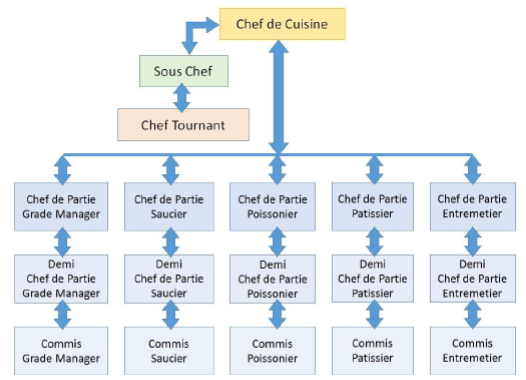
Kitchen Staff

Design Considerations of a Commercial Kitchen

Since a large quantity and variety of food is produced in the professional kitchens, various designs are considered before setting up a kitchen. The food production managers must consider the following factors with respect to the kitchen.
  • Restaurant menu and service types
  • Heating, ventilation, and air conditioning
  • Employee workflow
  • Storage, food production, cleaning, and service space
  • Equipment
  • Drainage and plumbing
  • Communication among employees
  • Safety of employees and property

Typical Layouts of a Commercial Kitchen

Some typical layouts of a commercial kitchen are given below.

Island Layout

In this type of layout, the cooking ranges, ovens and other cooking equipment are placed together at the center of the kitchen. The other sections are placed along the wall in order to follow a concentric design. Any section can be an island depending on the requirements.
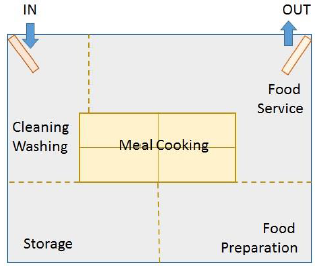
Island Layout
It is an open layout that favors staff communication. It also leaves an adequate open floor space for cleaning. This layout is followed in large kitchens.

Zonal Layout

The total kitchen space is divided into different zones for various activities. The principle equipment are located along the walls. This layout follows an appropriate order.
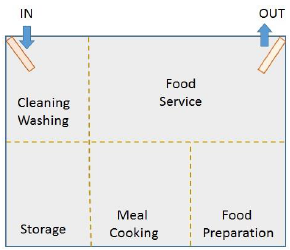
Zonal Layout
In this layout, staff communication and supervision are easy as the central space is completely open.

Assembly Line Layout

In this layout, kitchen equipment is organized in a row. The food preparation space is kept at one end and the service space at the other. The areas for cleaning/washing and storage/receiving are behind the assembly line to keep them separate from the main busy space. This allows the cooks to send the food quickly down the line. This layout provides very high efficiency, and excellent communication and workflow.
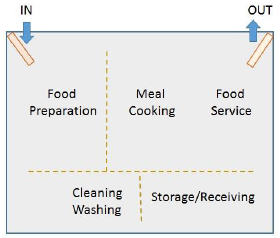
Assembly Line Layout
This layout is very effective in case of the establishments with a limited menu with large momentum.


Front Office Management-Ranks and Responsibilities

Reservation Manager

In the context of hotel, the term reservation is used for booking a particular accommodation in the hotel by a guest for a period of time. Reservation section does not directly deal with the guests.
Reservation Manager
Some important tasks a reservation manager is responsible for are −
  • Having knowledge about the reservation systems.
  • Providing and updating information on tours, prices, and itineraries.
  • Reviewing daily hotel reservations.
  • Preparing occupancy forecast.
  • Updating travel agent rates in the system.
  • Handling correspondence with outside travel agencies.
  • Allocating daily tasks to the reservation staff.
  • Ensuring special deals with repeat guests, VIPs, or guest groups.
  • Training the staff under hand.

Reception Manager

Following are some prominent roles and responsibilities of the reception manager −
  • Dealing with arrival and departure of the guests.
  • Welcoming the guests, escorting them to the room, and seeing them off.
  • Ensuring professional greeting of clients, visitors, and guests.
  • Coordination with housekeeping department for cleaning rooms.
  • Filling registration cards for the guests with reserved accommodation or help the guests to fill it up.
  • Arranging surprise gift for the guests on their special days.
  • Training of receptionists.
  • Handling appraisals and performance rewards of the staff.
  • Reviewing current standards of front office services and procedures, and implementing new practices if required.
  • Ensuring and Scheduling front office desk staff.
  • Managing VIP functions and events taking place in the hotel.
  • Upgrading software if required.
  • Updating backup database regularly.
Reception Manager

Guest Services Manager

The responsibilities of the guest service manager include −
  • Handling guest mails, letters, and couriers.
  • Ensuring guest messages are delivered at the right time.
  • Training the guest service staff such as concierges, bell staff, wallet parking staff, and porters.
  • Maintaining guest service suggestion cards and guest complaints.
  • Scheduling and appraising guest service staff.
  • Ensuring the staff delivers services, accurately and timely.
Guest Services Manager

Night Audit Manager

This manager works during the night hours. The typical responsibilities of a night audit manager are &mnus;
  • Posting accommodation charges, taxes, and other paid services such as restaurant, Internet charges to each guest's account accurately.
  • Taking the responsibility as a duty manager for night shift.
  • Settling guest accounts if required.
  • Authoring security of the hotel during night shift.
Night Audit Manager

Communication Manager

The communication manager is responsible for −
  • Keeping in check all communication facilities such as PBX, facsimile, internet in the hotel.
  • Training and scheduling telephone operators in case of large hotels.
  • Ensuring immediate delivery of fax to the guests, if required.
  • Appraising telephone operators.
  • Changing the communication systems to the latest technology for easy use.
Communication Manager

Front Office - Staff Qualities and Competencies

Being a part of the service industry, the front office staff needs to have the following qualities and competencies. The front office staff members are required to −
  • Understand their respective roles and responsibilities in the hotel and front office as an operation.
  • Equip themselves with basic etiquettes and mannerism.
  • Possess pleasant, polite, and cordial personality.
  • Wear clean and neat uniform with same accessories and footwear.
  • Conduct themselves with professionalism, positive attitude, and cooperative nature.
  • Possess extraordinary communication skills.
  • Be a team player.
  • Possess the ability to tackle tricky situations.

Front Office Management - Structure

Front office area is commonly termed as ‘Reception’, as it is the place where the guests are received when they arrive at the hotel. It is the first point of interaction between the hotel and the guests. Being the prime interface between the hotel services and the guests, the front office is located near the main entrance of the hotel.
The front office structure can be viewed in two ways: the physical setup and the operational structure of the department.

Physical Setup of Front Office

The physical setup includes key-hanging boards, bell desk and guest-mail handling register. The front desk is equipped with various compartments, the computerized property management system, and an in-house communication system.

Positioning the Front Desk

The front desk is where the guests temporarily await to find an accommodation or to clear their bill. Hence, it needs to be positioned appropriately such that the staff and the guests can use them conveniently. The front desk needs to be −
  • Positioned at an adequate height and reach.
  • An adequately lit-up area.
  • Aesthetically furnished.
  • Preferably near the hotel lobby and lift.
  • Preferably near the sitting area.
  • Wide enough to make the staff member communicate with the guests across the desk.

Front Office Communication

The front office staff needs to communicate with the staff of the same as well as all other departments of the hotel. This is termed as internalcommunication. It mostly relies upon the PBX or IP-PBX system.
When the front office communicates with the potential customers outside the hotel, corporate offices, and other ancillary service providers, then it is an external communication.
Any formal communication outside the hotel is mostly carried out using e-mails and phone calls. For sending coupons or other promotional material, renewing agreements with travel agents or airlines, the front office staff may opt for postal mail.

Operational Structure of Front Office

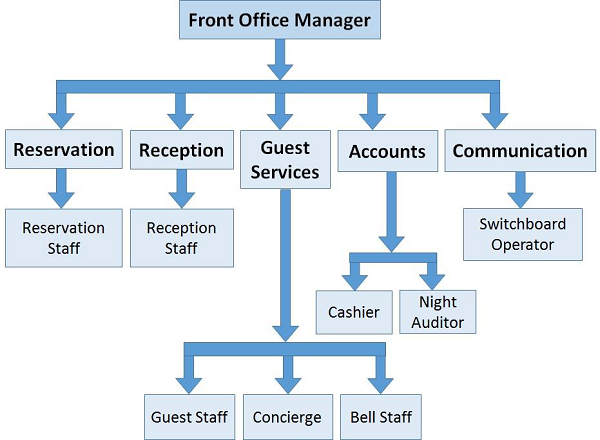
There are lot of staff working under front office manager. The structure of the front office department changes according to the size of the hotel business, physical size of the hotel, and the hotel management policies. Following is the general structure of the front office department −
Operational Structure of Front Office

Hotel Front Office Sections

Front office department manager heads the team of staff working on various activities and responsibilities in the front office department. Few prominent activities that the front office staff is involved in are −
  • Reservation − It includes handling request of customers for reserving accommodations.
  • Reception − It includes receiving the guests according to the highest standards and registering them appropriately. It also includes bidding the guests off.
  • Guest Services − They are also known as Uniformed Services. It includes personalized guest services such as −
    • Handling guest luggage.
    • Handling guest mail.
    • Delivering newspapers in accommodations.
    • Paging the guest inside the hotel (locating the guest in the hotel).
    • Arranging for a doctor in emergency.
    • Parking guest’s automobiles.
    • Arranging for reservations at the places of entertainment outside the hotel.
  • Accounts − It mainly includes a front office cashier and a Night Auditor. The cashier is responsible for handling guest payments. He typically reports to the accounts manager rather than the front office manager.
    The night auditor performs the duties of front desk reception as well as accounting partly during the night shift. He needs to report to the heads of both departments, front office, and accounting.
  • Communication − It involves handling communication among various other departments and guests of the hotel.

Front Office Management - Terminology

Following are some common terms used in relation to the front office department −
S. No.Term & Meaning
1
Account receivables
The amount of money an organization has the right to receive within some specified period (say 30 days) against the delivery of products/services.
2
Bell desk
An extension of front desk that deals with personalized guest services.
3
Cancellation charges
They are the charges borne by the guest on cancellation of a confirmed reservation or for not showing-up on confirmed reservation.
4
Concierge
Information desk that assists guests for transportation, booking of events outside the hotel.
5
GRC
Guest Registration Card, which the guest needs to fill in with personal formation at the time of registration.
6
Guest
Customer of the hotel business being served.
7
IP-PBX
Internet Protocol Private Branch Exchange, where internet protocol is used for call transmission.
8
MICE
Acronym for Meetings, Incentives, Conferences, and Exhibitions.
9
Non-guest
Customer of a hotel business not being served at the moment.
10
No-show
A guest who has reserved an accommodation neither turns up nor cancels it.
11
OHMS
Online Hotel Management System, a software system to manage all back-office operations of a hotel.
12
PBX
Private Branch Exchange, a private network of telephones within an organization.
13
POS
Acronym for Point of Sale. It is the revenue generating place in the hotel where retail transactions are carried out.
14
Rack rate
The price at which the hotel rooms are sold before applying discount.
15
SMERF
Acronym for Social, Military, Educational, Religious, and Fraternal.
16
Trial balance
It is a report of accounts that represents ending balance of each account in the list. It is prepared at the end of an accounting period.
17
Uniformed services
Personalized services provided to the guests.
18
Valet
A male attendant to park and clean the car.
19
Whitney System
An old reservation system for hotel accommodations.
20
Yield Management
A variable pricing strategy, based on understanding, anticipating and influencing consumer behavior in order to maximize revenue from a fixed, perishable resource.

Front Office Management - Introduction

What is Front Office Department?

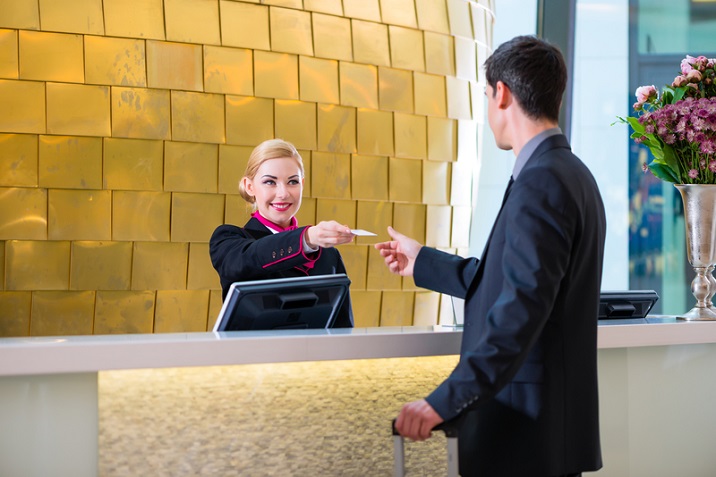
It is the one of the many departments of the hotel business which directly interacts with the customers when they first arrive at the hotel. The staff of this department is very visible to the guests.
Front office staff handles the transactions between the hotel and its guests. The staff receives the guests, handles their requests, and strikes the first impression about the hotel into their minds.
Front Office Department
Front office department includes −
  • Front Desk
  • Uniformed services
  • Concierges
  • Front Office Accounting System
  • Private Branch Exchange (PBX), a private telephone network used within an organization

Basic Responsibilities of Front Office Department

Following are the most basic responsibilities a front office can handle.
  • Creating guest database
  • Handling guest accounts
  • Coordinating guest service
  • Trying to sell a service
  • Ensuring guest satisfaction
  • Handling in-house communication through PBX

Front Office Operations

There are two categories of Front Office Operations −

Front-House Operations

These operations are visible to the guests of the hotel. The guests can interact and see these operations, hence, the name Front-House operations. Few of these operations include −
  • Interacting with the guests to handle request for an accommodation.
  • Checking accommodation availability and assigning it to the guest.
  • Collecting detail information while guest registration.
  • Creating a guest’s account with the FO accounting system.
  • Issuing accommodation keys to the guest.
  • Settling guest payment at the time of check-out.

Back-House Operations

Front Office staff conducts these operations in the absence of the guests or when the guest’s involvement is not required. These operations involve activities such as −
  • Determining the type of guest (fresh/repeat) by checking the database.
  • Ensuring preferences of the guest to give a personal touch to the service.
  • Maintaining guest’s account with the accounting system.
  • Preparing the guest’s bill.
  • Collecting the balance amount of guest bills.
  • Generating reports.

Guest Cycle in Hotel

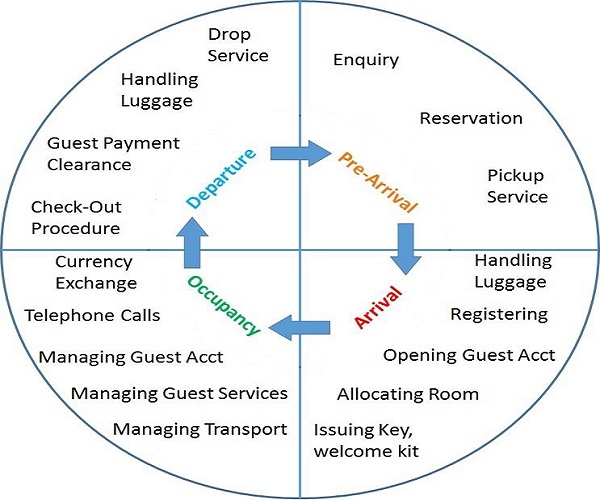
Generally, a guest’s interaction with the hotel is divided into the following four sequential phases −

Pre-arrival

It is the stage when the customer is planning to avail an accommodation in the hotel. In this first stage, the customer or the prospective guest enquires about the availability of the desired type of accommodation and its amenities via telephonic call or an e-mail. The customer also tries to find out more information about the hotel by visiting its website.
At the hotel end, the front office accounting system captures the guest’s information such as name, age, contact numbers, probable duration of stay for room reservation and so on.

Arrival

The front office reception staff receives the guest in the reception. The porters bring in the guest luggage. For the guest with confirmed reservation, the front office clerk hands over a Guest Registration Card (GRC) to the guest and requests the guest to fill in personal information regarding the stay in the hotel. The clerk then registers the guest in the database thereby creating a guest record and a guest account along with it. Later, the clerk hands over a welcome kit and keys of the accommodation. After the procedure of registration, the guest can start occupying the accommodation.

Occupancy

During occupancy, a front office accounting system is responsible for tracking guest charges against his/her purchases from the hotel restaurants, room service, bar, or any outgoing telephone calls made via the hotel’s communication systems. The front office staff is responsible to manage and issue the right keys of the accommodations to the right guests. On guests’ request, the staff also makes arrangement for transportation, babysitting, or local touring while the guest is staying in the hotel.
Guest Cycle in Hotel

Departure

During guest departure, the front office accounting system ensures payment for goods and services provided. If a guest’s bill is not completely paid, the balance is transferred from guest to non-guest records. When this occurs, collection becomes the responsibility of the back office accounting division.
At the time of guest departure, the front office staff thanks the guest for giving an opportunity to serve and arrange for handling luggage. In addition, if the guest requires airport or other drop service, the front office bell desk fulfils it.